
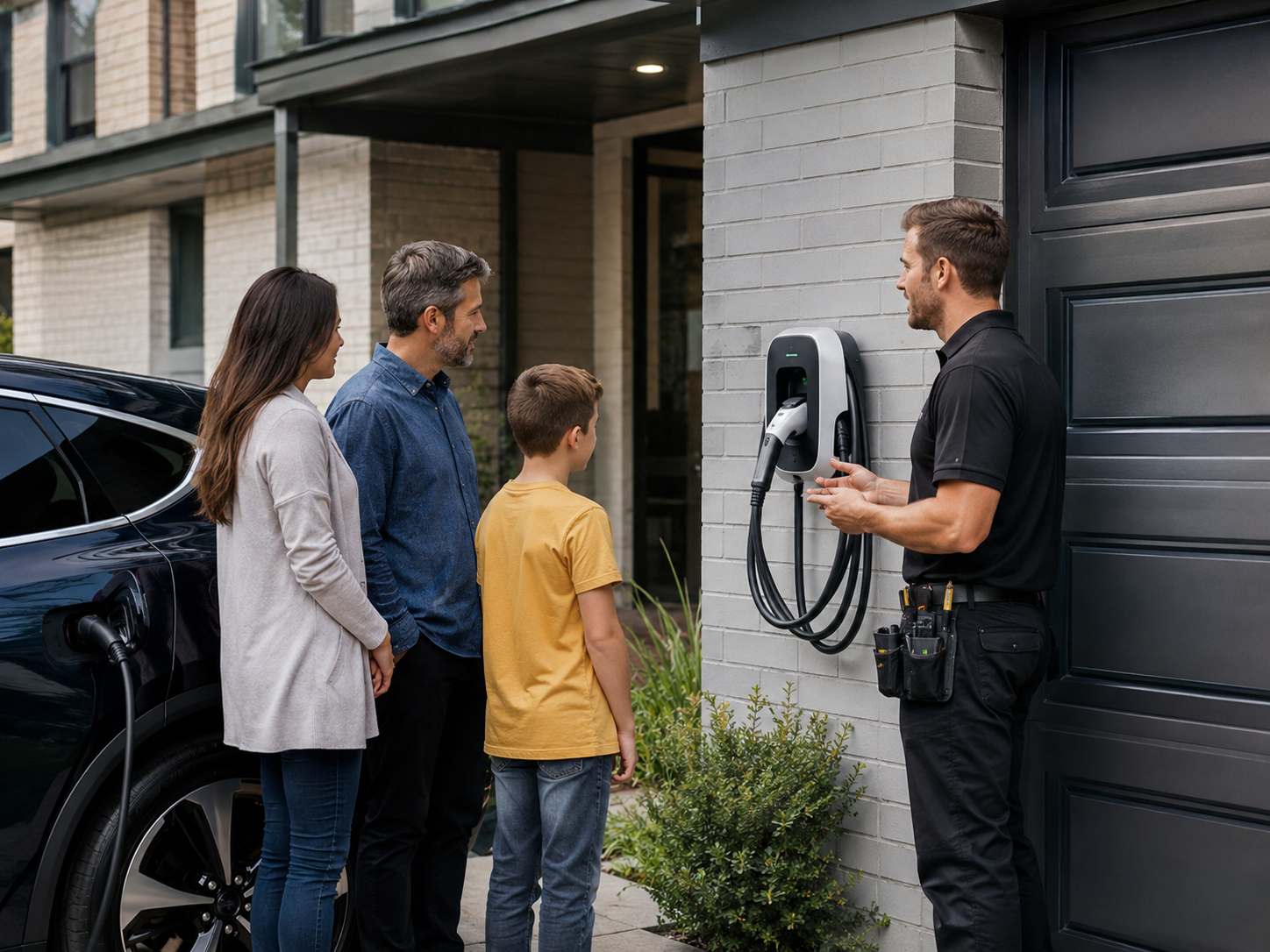
If your Toronto home’s electrical panel is in the basement, your EV charger does not need to be installed close to the panel.
The best charger location is usually determined by where you park, where the vehicle’s charging port is located, cable reach, weather exposure and the practical route for running a new electrical circuit from the basement panel.
ESA recommends positioning home charging equipment so the charger and vehicle charge port are conveniently located without requiring the charging cable to run unnecessarily across the garage.
For many Toronto homes, that means mounting the Level 2 charger inside an attached garage or on an exterior wall beside the driveway while routing the electrical wiring back to the basement panel. A professional EV Charger Installation assessment can help determine both the best charger location and the most practical wiring route from a basement electrical panel.
Should the Charger Be Close to the Electrical Panel?
Not necessarily.
Installing the charger close to the panel can reduce wiring distance, but convenience at the parking location is usually more important.
Imagine your panel is at the front of the basement while your vehicle is parked at the rear of the house. Installing the charger near the panel would accomplish little if the charging cable could not comfortably reach the vehicle.
Instead, an electrician can evaluate a wiring route from the panel to the parking area.
Common routes may include:
- across an unfinished basement ceiling;
- through accessible floor joists;
- through finished basement areas where access is possible;
- through the home’s exterior wall;
- through approved conduit outside; or
- into an attached garage.
The most practical route depends on the construction of the house.
Where Is the Best Location Inside an Attached Garage?
If you have an attached garage, the charger should generally be positioned where the charging cable can reach your vehicle without creating a trip hazard or being stretched across the garage.
Before choosing a wall, consider:
Where do you normally park?
Front-in and reverse-in parking can place the charge port in completely different locations.
Where is the EV’s charging port?
Some vehicles have the port near the front, others at the rear or side.
Could you buy a different EV later?
A slightly more central charger location may offer greater flexibility.
Will anything block the charger?
Storage cabinets, shelves, garbage bins and garage equipment can interfere with access.
ESA specifically recommends planning the charging location around how the vehicle is parked and keeping the charger and charge port reasonably close together.
Can the Charger Be Installed Outside?
Yes, provided the equipment is approved and suitable for the location.
Outdoor charging can be practical for Toronto homes without a garage or where the driveway provides the normal parking location.
The charger should be installed where it is convenient to use while minimizing exposure to physical damage.
Your contractor also needs to select equipment approved for the environment in which it will operate. ESA requires EV charging systems used in Ontario to carry an accepted Canadian certification mark or label.
For an outdoor Toronto installation, factors such as snow, rain, vehicle movement and cable storage should therefore be considered before the mounting position is finalized.
Does a Finished Basement Make Installation Harder?
Usually, yes.
An unfinished basement often gives an electrician relatively direct access to floor joists and wiring routes.
A finished basement may require a more creative route to avoid unnecessary drywall damage.
Depending on the house, the electrician may be able to use:
- utility rooms;
- mechanical spaces;
- existing accessible pathways;
- unfinished ceiling sections; or
- an exterior wiring route.
The shortest route is not always the best route. Accessibility, protection of the wiring and minimizing disruption to finished areas also matter.
What If the Garage Is on the Opposite Side of the House?
A longer distance generally increases installation complexity.
Longer runs require more cable and labour and may involve additional routing through finished areas or outside the house.
However, having a basement panel far from the garage does not automatically prevent Level 2 charging.
An electrician can determine the most practical code-compliant pathway and size the circuit appropriately for the installation.
Should I Install the Charger Beside the Garage Door?
It can be a useful location because a charger near the garage opening may sometimes reach a vehicle parked either inside or immediately outside.
But cable management matters.
You do not want a charging cable regularly trapped beneath the garage door, stretched across walkways or exposed to unnecessary physical damage.
The final location should accommodate how you actually use the garage rather than simply choosing whichever wall is closest to the electrical panel.
Does Panel Capacity Still Need to Be Checked?
Yes.
Finding a good wiring route does not establish that the electrical service has sufficient capacity for the charger.
Toronto Hydro recommends evaluating the home’s existing electrical capacity before installing Level 2 charging because upgrades may be required depending on existing demand.
A Licensed Electrical Contractor should assess both:
- where the charger should go; and
- whether the existing electrical system can support it.
If capacity is limited, charger configuration, energy management or an electrical upgrade may need to be considered.
Do I Need an ESA Permit?
Yes.
ESA states that all EV charger installations require an electrical permit, also called a Notification of Work, before the electrical work begins. If you hire someone to perform the electrical work in Ontario, that contractor must be a Licensed Electrical Contractor.
Final Answer
If your Toronto electrical panel is in the basement, place the EV charger where it is most practical for the vehicle and design the electrical route back to the panel—not the other way around.
For most homes, that means mounting the charger inside an attached garage or beside the driveway, close enough to the vehicle’s charge port for convenient daily use.
The electrician can then evaluate the best route through the basement, exterior or garage while considering wiring distance, finished surfaces, electrical capacity and ESA requirements.