
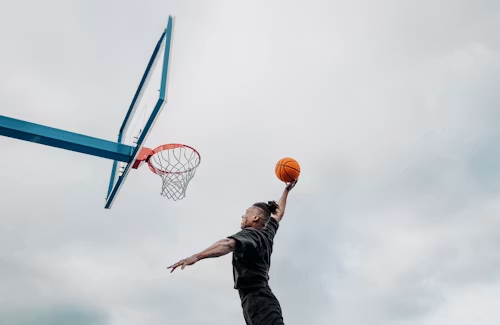
Of all the measurements involved in calculating your dunking potential, standing reach is the most important and the most commonly measured inaccurately. Your standing reach — the height your fully extended arm reaches from a standing position — is the baseline from which your jumping ability adds distance toward the ten-foot rim. Even small errors in this measurement translate directly into errors in your calculated vertical jump requirement, leading to misinformed training targets and frustrating discrepancies between calculated and observed dunking ability.
What Standing Reach Measures
Standing reach is measured as the height from the floor to the highest point your outstretched fingers can reach when standing flat-footed with your dominant arm fully extended overhead. For accurate jump measurements, dunk calculator tools provide the exact figures you need. It combines your height, arm length, and shoulder flexibility into a single number that directly determines how high your hand can reach without jumping. For dunking purposes, your effective reach needs to clear the 10-foot rim while holding a basketball — making this measurement the most critical single variable in your dunking calculation.
Common Measurement Errors to Avoid
The most common errors in standing reach measurement are: rising onto the toes (even slightly) during measurement, failing to fully extend the shoulder joint overhead, not fully straightening the elbow, and not accounting for whether you’re measuring with the palm flat against the wall or with fingers extended. Each of these errors can add 1 to 4 inches of false reach, significantly overestimating your actual standing reach and creating misleading calculations of your vertical jump requirement.
Step-by-Step Measurement Protocol
For a reliable standing reach measurement: stand barefoot on a flat, hard surface with both feet flat on the floor and your back and heels touching a wall. Extend your dominant arm fully overhead, rotating the palm outward and extending the shoulder as high as possible — but without lifting your heels. Have a partner mark the highest point reached by the middle finger or use a piece of chalk on your fingertips to mark the wall. Measure from the floor to this mark. Repeat three times and average the results.
Factors That Affect Standing Reach
Standing reach is affected by height, arm length, shoulder flexibility, and hand size. Athletes with above-average arm length relative to their height (a wingspan-to-height ratio greater than 1.0) have proportionally higher standing reaches than their height alone would suggest. Conversely, athletes with relatively shorter arms have lower standing reaches. Improving shoulder flexibility through consistent stretching and mobility work can add a genuine 1 to 2 inches to your standing reach over time.
How Standing Reach Changes With Age and Training
Standing reach changes over time, though more modestly than vertical leap. In growing athletes, it increases naturally as height and arm length increase with physical maturation. In adult athletes, it can improve slightly through shoulder mobility work and improved posture. Conversely, sedentary adults who develop thoracic kyphosis (rounded upper back) may see their effective standing reach decrease over time. Regular overhead mobility work and good postural habits preserve and modestly improve standing reach.
Using Your Standing Reach to Calculate Dunking Requirements
Once you have your accurate standing reach, calculating your vertical jump requirement for dunking is straightforward. The standard dunking threshold is approximately 10 feet 6 inches (to ensure the hand clears the rim while holding the ball). Subtract your standing reach from 10 feet 6 inches to get the minimum vertical leap needed. For example, a standing reach of 7 feet 8 inches requires a minimum 34-inch vertical leap. This number is your training target — the specific goal your entire training program is working to achieve.